


Falsified bank statements used to be easy to spot. They aren't any more. Editing tools, online template farms and now AI generation produce statements of remarkable quality, and the lenders most exposed are the ones whose processes run on documents.
The common answer is that Open Banking solves this. For some lending it does. But a large share of UK commercial and specialist lending is broker-introduced: the deal arrives as a package of PDFs shopped to a panel of lenders, and no applicant is authorising live data pulls for five or six firms at once. Documents remain the reality of underwriting — which means the documents themselves need checking.
What ExactSum Now Does
Every statement processed by ExactSum now passes through a document forensics engine. It looks at three independent things:
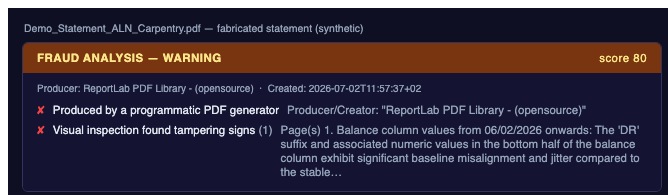
- File forensics. Who actually produced the PDF — banks' publishing systems leave very different fingerprints from Photoshop, Word or online PDF editors — plus hidden edit traces and whether the file was modified after it was created.
- Mathematical reconciliation. Every transaction is checked to the penny against the printed running balance, and totals against the statement's own summary. Fabricated numbers rarely add up.
- Visual inspection. Fonts, alignment and rendering inside the figures — the tells left behind when an amount has been pasted over.
Verdicts, Not Scores
Nobody knows what to do with a "68% risk score". Each document instead gets a plain-English verdict — Normal, Warning or High Risk — with the specific findings spelled out. Here is a genuine Lloyds statement coming back clean:
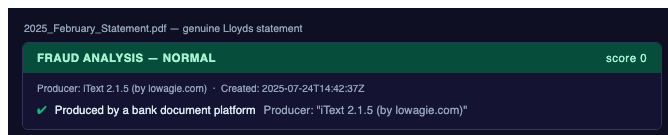
And here is a statement we fabricated ourselves to test the engine, being caught:
In Beta, Running on Everything
This is in beta. It already runs across every document ExactSum processes, and we are tuning it against thousands of genuine statements so false alarms stay near zero before the verdicts appear in customer workflows. Verdicts can also feed the Decision Engine — a "no fraud concerns" rule that pulls a case to Refer the moment a document is rated High Risk.
Standalone document-forensics tools charge £3–4 per check. For ExactSum customers this will simply be part of the product.
If you'd like the verdicts surfaced for your team during the beta, or a walkthrough on your own statements, book a demo or get in touch.